

Hypertension
Latest News


December 2nd 2025
The Priority Review decision is based on phase 3 results showing consistent SBP reductions across uncontrolled and treatment-resistant hypertension subgroups.


More News


Man With Chest Pain After Cocaine Use
May 1st 2006A 53-year-old man presents to the emergency department(ED) with chest pain that started the previous night. Thepain began about 30 minutes after he had smoked marijuanaand inhaled cocaine. He describes the pain as tightnessin the left side of the chest that radiates into theneck; he also has a tingling sensation in both the left sideof the neck and the left arm.
Diagnostic Puzzlers: A patient with progressive dyspnea and right heart failure
May 1st 2006A 64-year-old woman with a history of uncorrected ventricular septal defect was hospitalized with progressive dyspnea and right heart failure. The patient had recently emigrated to the United States, where she received the diagnosis of ventricular septal defect with significant pulmonary arterial hypertension (Eisenmenger syndrome).
Exercise intolerance in severe COPD: A review of assessment and treatment
May 1st 2006Abstract: Exercise intolerance is common in persons with chronic obstructive pulmonary disease and can result from multiple physiologic factors, including dynamic hyperinflation, gas exchange abnormalities, and pulmonary hypertension. In the initial assessment, keep in mind that many patients underestimate the degree of their impairment. The 6-minute walk test is very useful in assessing the degree of exercise intolerance; when more extensive assessment is indicated, cardiopulmonary exercise testing (CPET) is the gold standard. CPET is particularly useful for defining the underlying physiology of exercise limitation and may reveal other causes of dyspnea, such as myocardial ischemia or pulmonary hypertension. Strategies for improving exercise tolerance range from the use of bronchodilators and supplemental oxygen to participation in a pulmonary rehabilitation program. (J Respir Dis. 2006;27(5):208-218)
Atrial Fibrillation:When - and How - to Convert to Sinus Rhythm
April 1st 2006Your patient with atrial fibrillation (AF)is hemodynamically stable and youhave successfully established rate control.Your next step is to weigh therisks and benefits of attempting to restoresinus rhythm. In up to one half ofpatients, AF of recent onset convertsspontaneously to normal sinus rhythmwithin 24 hours. Thus, in some cases,the most appropriate approach maybe to control the ventricular response,identify and treat comorbid conditions,initiate anticoagulation, and closelymonitor the patient.
Atrial Fibrillation: How Best to Use Rate Control and Anticoagulation
April 1st 2006Atrial fibrillation (AF) is the most commonsustained cardiac arrhythmia; itaffects about 2.2 million Americans.The prevalence of AF, which increaseswith age,1 is approximately 5.9% in personsolder than 65 years2 and greaterthan 10% in those older than 75 years.3
Diagnostic Puzzlers: What caused this patient's chest wall mass?
April 1st 2006A 66-year-old man presented with weight loss for 2 months, loss of appetite for several weeks, and abnormal chest radiographic findings. He denied chest pain, cough, fever, chills, shortness of breath, and chest trauma. He was an active smoker, with a 50-pack-year history of smok- ing, and a cocaine and alcohol abuser. His history included treatment of hypertension for 10 years and treatment of pulmonary tuberculosis 14 years previously.
Obstructive sleep apnea syndrome, part 1: Identifying the problem
April 1st 2006Abstract: Obstructive sleep apnea-hypopnea syndrome (OSAHS) is a common, yet often overlooked, form of symptomatic sleep-disordered breathing. OSAHS is a cause for concern for several reasons, one of which is its association with cardiovascular disease. Risk factors include obesity, hypertension, and upper airway malformations. Diagnostic clues include habitual snoring, witnessed apneas, choking arousals, excessive daytime sleepiness, and large neck circumference. Polysomnography is the definitive diagnostic test; it pro- vides objective documentation of apnea and hypopnea. Since OSAHS may contribute to adverse postsurgical events, consideration of this syndrome should be part of the preoperative assessment of patients. (J Respir Dis. 2006;27(4):144-152)
Severe Migraine: Options for Acute Therapy in the Emergency Department
March 2nd 2006A 36-year-old man with a 15-year history of episodic migraine presents to the emergency department (ED) at 5 AM witha right-sided throbbing headache of 4 hours' duration. The headache awakened him, which is typical of his more severemigraine attacks. Unfortunately, the patient forgot to refill his prescription for pain medication and did not "catch" thisheadache in time. He took an over-the-counter combination of aspirin and caffeine, which seemed to help for about 60minutes, but the headache has returned full force. He has vomited twice-another characteristic typical of his migraineattacks
Consultant Health Guide: Keys to Successful Weight Loss
March 1st 2006Excess weight increases the risk of having a heart attack, stroke, high blood pressure, arthritis, diabetes, depression, fatigue, and certain types of cancer. Losing weight and keeping it off are very difficult for most persons who are overweight. Here are some suggestions to help you lose pounds and keep your weight down.
Case In Point: Middle-Aged Man With Worsening Cough and Dyspnea
A 52-year-old man with hypertension and hyperlipidemia presents to the emergency department with a 5-month history of cough and dyspnea.
Cholesterol (Hollenhorst) Plaque
January 31st 2006A 71-year-old man presented with a 6-week history of decreased vision in his right eye. The patient, who had hypertension and migraine headaches, had successfully recovered from a stroke that occurred 1 year earlier. His medications included aspirin, 81 mg/d, clopidogrel, atenolol, and furosemide. He also took gabapentin, 300 mg hs, for his migraine headaches. He had a remote history of cigarette smoking.
Generalized Tonic-Clonic Seizure in a Man with Chronic Hypertension
January 19th 2006A 62-year-old businessman of Japanese descent is brought to the emergencydepartment less than half an hour after he experienced a generalized tonic-clonicseizure during a dinner meeting. His consciousness is markedly diminished(he is incoherent and barely arousable).
Antihypertensives and Diabetes: Is There a Connection?
January 1st 2006The prevalence of type 2 diabetes is expected to continue to increase rapidly, and it is not surprising that the issue of the potential effects of different classes of antihypertensive drugs on glucose metabolism and glycemic control has sparked debate.
Case In Point: A man with renal failure, dyspnea, and an apparent lung mass
December 1st 2005A 54-year-old man with chronic renal insufficiency presented with shortness of breath, nonproductive cough, and chest pain. The patient had hypertension, type 2 diabetes mellitus, and a 30-pack-year history of cigarette smoking. He denied alcohol or illicit drug use and prolonged exposure to asbestos, chemicals, or fumes.
Woman With Facial Asymmetry of Abrupt Onset
December 1st 2005A 57-year-old woman complains of burning and dryness in her left eye and altered sensation in her mouth when eating; these symptoms began the day before. A coworker who had noticed facial asymmetry recommended that she seek medical attention.
Type 2 Diabetes, the Metabolic Syndrome, Inflammation, and Arteriosclerosis:
December 1st 2005Up to 10% of Americans older than 20 years have type 2 diabetes, and more than 20% have the metabolic syndrome. The prevalence of both diseases has risen by 33% over the past decade as a result of an increasingly sedentary lifestyle, the obesity epidemic, the growth of ethnic groups at risk for the disease, and the aging of the population.
Pseudomembranous Enterocolitis in an Older Woman
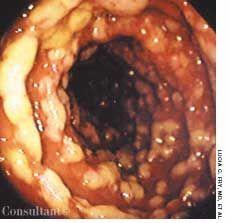
November 18th 2005For 2 days, a 68-year-old woman had watery, yellowish diarrhea with mucus and left lower quadrant pain. Her medical history included hypertension, diabetes mellitus, and congestive heart failure (CHF); she had left the hospital 5 days earlier following treatment of an exacerbation of CHF with intravenous furosemide and sodium and fluid restriction. The patient was taking furosemide, lisinopril, and glipizide; she denied any recent antibiotic therapy.

