

Atrial Fibrillation
Latest News


December 22nd 2025
Abbott's Volt PFA System gains FDA approval, offering a new minimally invasive treatment for atrial fibrillation, enhancing patient care options.


More News


Atrial Fibrillation: How Best to Use Rate Control and Anticoagulation
April 1st 2006Atrial fibrillation (AF) is the most commonsustained cardiac arrhythmia; itaffects about 2.2 million Americans.The prevalence of AF, which increaseswith age,1 is approximately 5.9% in personsolder than 65 years2 and greaterthan 10% in those older than 75 years.3
Wheezing in a 52-Year-Old Woman With a History of Colon Cancer
April 1st 2006A 52-year-old woman was admitted tothe hospital with progressive shortnessof breath of 2 days’ duration. Bronchialasthma had been diagnosed 6 monthsearlier; inhaled corticosteroids, bronchodilators,and leukotriene antagonistswere prescribed. Despite aggressivetreatment, the patient’s dyspneaand wheezing worsened.
Delirium in Elderly Patients:How You Can Help
April 1st 2006Delirium in older adults needs to berecognized early and managed as amedical emergency. Prompt detectionand treatment improve both shortandlong-term outcomes.1,2 Becausedelirium represents one of the nonspecificpresentations of illness in elderlypatients, the disorder can be easilyoverlooked or misdiagnosed. Misdiagnosismay occur in up to 80% of cases,but it is less likely with an interdisciplinaryapproach that includes inputfrom physicians, nurses, and familymembers.3
Obstructive sleep apnea syndrome, part 1: Identifying the problem
April 1st 2006Abstract: Obstructive sleep apnea-hypopnea syndrome (OSAHS) is a common, yet often overlooked, form of symptomatic sleep-disordered breathing. OSAHS is a cause for concern for several reasons, one of which is its association with cardiovascular disease. Risk factors include obesity, hypertension, and upper airway malformations. Diagnostic clues include habitual snoring, witnessed apneas, choking arousals, excessive daytime sleepiness, and large neck circumference. Polysomnography is the definitive diagnostic test; it pro- vides objective documentation of apnea and hypopnea. Since OSAHS may contribute to adverse postsurgical events, consideration of this syndrome should be part of the preoperative assessment of patients. (J Respir Dis. 2006;27(4):144-152)
Weakness and Nausea in an Elderly Woman
April 1st 2006An 86-year-old woman complains that she has felt "not at all well" for the past day. Her symptoms include diffuse generalized weakness and nausea; she denies chest pain, shortness of breath, abdominal pain, leg swelling, palpitations, and light-headedness. Five years earlier, a pacemaker was implanted as therapy for sick sinus syndrome and atrial fibrillation.
Elderly Woman With Episodes of Presyncope
April 1st 2006An 82-year-old woman presents with a history of sporadic episodes of light-headedness that began several months earlier and are becoming progressively more frequent. The episodes are unrelated to time of day, degree of activity, or posture. They cause her to feel as if she will lose consciousness, although she has never experienced total syncope.
Fatigue in a Woman With a Heart Murmur
March 2nd 2006A 59-year-old woman comes to your office for evaluation of her heart murmur.During the last several months, she has tired more easily and has had less energy.Recreational activities, such as lap swimming, have become difficult becauseshe is easily winded. She denies chest pain, foot swelling, and nocturnal dyspnea.
Q & A on Benefits of Coenzyme Q10
March 1st 2006A 3-year Australian study found that when patients who underwent bypass surgerywere given coenzyme Q10 for a week or more before the operation, their heartmuscle tolerated stress better, recovered more quickly, and had better pumpingability after surgery than did the heart muscle in patients given placebo.1
Warfarin Interactions: Update on the Most Common and Clinically Significant
March 1st 2006Numerous factors, includingother drugs, diseases,and diet, affectthe response to warfarin.Some of these factorsdecrease the response and maylead to therapeutic failure; othersenhance the response and may resultin life-threatening bleeding.
Understanding the basics of rigid bronchoscopy
March 1st 2006Abstract: In the assessment of central airway obstruction and disease, no imaging technique is an adequate substitute for bronchoscopy. The indications for rigid bronchoscopy include multiple malignant and benign disorders, with most interventions performed for treatment of complications of lung cancer. The rigid bronchoscope is a useful tool for managing most types of airway stenoses, and it facilitates other endobronchial therapies, including stent placement, argon plasma coagulation, balloon dilatation, electrocautery probes, and laser therapy. Certain patients with benign lesions or postintubation or post-tracheostomy stenosis may benefit from rigid bronchoscopic techniques instead of surgery. Although use of the rigid bronchoscope requires general anesthesia, it provides a stable airway and often results in fast removal of foreign bodies. (J Respir Dis. 2006;27(3):100-113)
Top Papers Of The Month: Stroke Prediction That's as Easy as ABCD
March 1st 2006n the first 7 days after a transient ischemic attack (TIA), the risk of a stroke is 10%.1 If half the patients who presented with TIAs were admitted and received an immediate workup within that 7-day window, only 5% of them would have a stroke.1 Thus, many patients would undergo unnecessary tests. Some would have complications, and the costs would be prohibitive. What is needed is a way to identify patients who are at high risk for a stroke in the immediate future--and who require emergent assessment.
Hereditary Hemochromatosis: Early Detection of a Common Yet Elusive Disease
February 1st 2006Although widely regarded as a raredisorder, hereditary hemochromatosisis the most common genetic disease inCaucasians. In certain populations ofnorthern European descent, 1 of every200 persons is homozygous for thecausative mutation.1
Spontaneous Internal Carotid Artery Dissection
February 1st 2006A 36-year-old man who had collapsedand sustained a bruised right shoulderwas brought to the emergency departmentwith acute emesis, cephalgia,blurred vision, aphasia, and righthemiparesis. He was confused but ableto follow simple commands.
Community-acquired pneumonia: An update on therapy
February 1st 2006Abstract: In the assessment of community-acquired pneumonia, an effort should be made to identify the causal pathogen, since this may permit more focused treatment. However, diagnostic testing should not delay appropriate empiric therapy. The selection of empiric therapy can be guided by a patient stratification system that is based on the severity of illness and underlying risk factors for specific pathogens. For example, outpatients who do not have underlying cardiopulmonary disease or other risk factors can be given azithromycin, clarithromycin, or doxycycline. Higher-risk outpatients should be given a ß-lactam antibiotic plus azithromycin, clarithromycin, or doxycycline, or monotherapy with a fluoroquinolone. If the patient fails to respond to therapy, it may be necessary to do bronchoscopy; CT of the chest; or serologic testing for Legionella species, Mycoplasma pneumoniae, viruses, or other pathogens. (J Respir Dis. 2006;27(2):54-67)
Whats The Take Home?: Worsening Fatigue and Dyspnea in a New Mother
February 1st 2006A 22-year-old woman presents with progressive fatigue and dyspnea on exertion that develops after she walks about 30 feet. She also reports orthopnea, lower extremity swelling, weight gain, dry cough, and paroxysmal nocturnal dyspnea.
Evaluating dyspnea: A practical approach
January 1st 2006Abstract: Shortness of breath is a common complaint associated with a number of conditions. Although the results of the history and physical examination, chest radiography, and spirometry frequently identify the diagnosis, dyspnea that remains unexplained after the initial evaluation can be problematic. A stepwise approach that focuses further testing on the most likely diagnoses is most effective in younger patients. Early bronchoprovocation challenge testing is warranted in younger patients because of the high prevalence of asthma in this population. Older patients require more complete evaluation because of their increased risk of multiple cardiopulmonary abnormalities. For patients who have multiple contributing factors or no clear diagnosis, cardiopulmonary exercise testing can help prioritize treatment and focus further evaluation. (J Respir Dis. 2006;27(1):10-24)
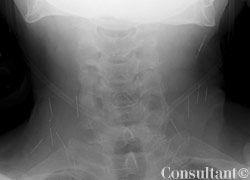
Broken Needles in the Neck of a Heroin Addict
January 1st 2006A 53-year-old man with a 30-year history of heavy injection drug use (10 to 15 bags of heroin per day) was hospitalized with fever (temperature, 39.2°C [102.5°F]) and chills of 2 days' duration. Infective endocarditis was diagnosed based on the results of 3 sets of blood cultures, which were positive for methicillin-sensitive Staphylococcus aureus.
Case In Point: A man with renal failure, dyspnea, and an apparent lung mass
December 1st 2005A 54-year-old man with chronic renal insufficiency presented with shortness of breath, nonproductive cough, and chest pain. The patient had hypertension, type 2 diabetes mellitus, and a 30-pack-year history of cigarette smoking. He denied alcohol or illicit drug use and prolonged exposure to asbestos, chemicals, or fumes.
Clinical Update: Heparin-induced thrombocytopenia: Highlights of recent studies
December 1st 2005Heparin-induced thrombocytopenia (HIT) is a potentially life-threatening complication that occurs in about 1% to 5% of patients who receive heparin.1 Patients with HIT are at risk for the development of new thrombosis, including pulmonary embolism (PE). The mortality rate among patients with HIT and thrombosis is about 20% to 30%.2-5
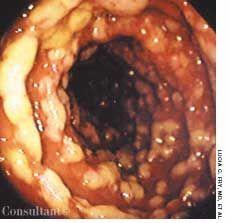
Pseudomembranous Enterocolitis in an Older Woman
November 18th 2005For 2 days, a 68-year-old woman had watery, yellowish diarrhea with mucus and left lower quadrant pain. Her medical history included hypertension, diabetes mellitus, and congestive heart failure (CHF); she had left the hospital 5 days earlier following treatment of an exacerbation of CHF with intravenous furosemide and sodium and fluid restriction. The patient was taking furosemide, lisinopril, and glipizide; she denied any recent antibiotic therapy.

