Infectious Disease
Latest News


December 22nd 2025
Injection anxiety and concerns about side effects are common. A primary care physician outlines practical counseling strategies, expectation-setting, and interventions that improve patient comfort and confidence.


More News

Congenital Sensory Neuropathy Type IV (Congenital Insensitivity to Pain with Anhidrosis)
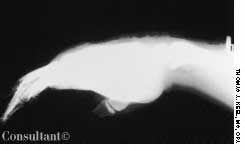
September 14th 2005A 6-year-old girl presented with a huge ulcer on her right heel, seen here, that began as a minor laceration when she stepped on a rock several months earlier. On the left heel, there was a similar lesion in the process of healing that had also followed a minor injury. Her feet and hands were dry and hyperkeratotic.






Tinea Manuum and Tinea Unguium
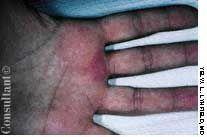
September 14th 2005For about 4 months, a very dry, diffuse, fine scaly, asymptomatic eruption covered the palms of a 28-year-old man; several fingernails were dystrophic bilaterally as well. Before the onset of this condition, bilateral onychomycosis of the toenails had been diagnosed.


Inhaled Corticosteroids Lower Death Risk in COPD
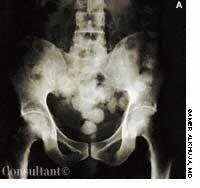
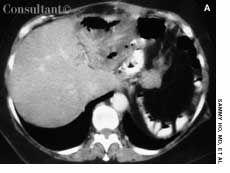
September 14th 2005This condition involves the invagination of a proximal segment of bowel (the intussusceptum) into a more distal segment (the intussuscipiens). It occurs most frequently in infants between the ages of 5 and 12 months and is a leading cause of intestinal obstruction in children aged 2 months to 5 years. Intrauterine intussusception is associated with the development of intestinal atresia. The male to female ratio is approximately 3:2. Intussusception is slightly more common in white than in black children and is often seen in children with cystic fibrosis.
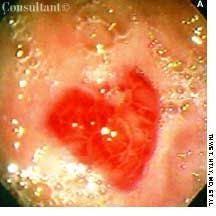


Pyogenic Granuloma on Upper Eyelid
September 14th 2005A 55-year-old woman complained of the sensation of a foreign body in her swollen left upper eyelid. A hard, painless lump was readily discerned during palpation. Eversion of the left upper eyelid revealed a fleshy, red, sessile conjunctival mass. No purulent drainage was noted.

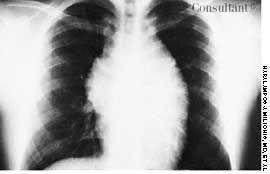
T-Cell Acute Lymphoblastic Leukemia and Mediastinal Mass
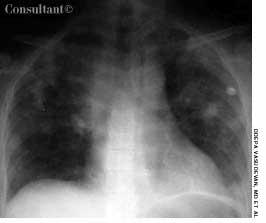
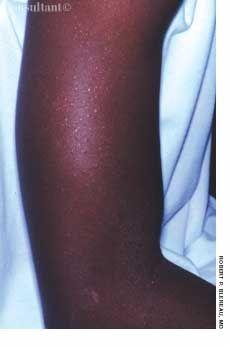
September 14th 2005A 19-year-old man was admitted to the hospital with malaise, fatigue, and intermittent fever (temperature of 38°C [100.4°F]) for the last 2 weeks. Physical examination revealed scarce purpuric lesions over the lower extremities; a pericardial friction rub was audible over the precordium when the patient was supine and seated, and the spleen was remarkably enlarged.

Negative-Culture Tinea Corporis
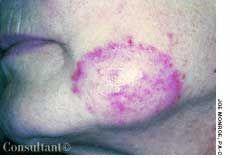
September 14th 2005A 49-year-old man was concerned about a right flexor forearm lesion that had been increasing in size for 6 weeks. The light pink, well-demarcated, 5-cm, circular lesion featured slight peripheral elevation with ulceration, crusting, and a relatively clear central area. A culture of material from the lesion was negative for fungi. A potassium hydroxide evaluation was not performed.