

Lung Cancer
Latest News


December 10th 2025
Episode highlights include a new AD blood test for PCPs, sleep effects of elinzanetant among postmenopausal women, lung cancer screening gains, and more.



More News


Quick Take: Do dietary phytoestrogens reduce the risk of lung cancer?
January 1st 2006Dietary phytoestrogens are plant-derived nonsteroidal compounds that have weak estrogen-like activity. The 3 main classes of phytoestrogens are isoflavones, lignans, and cumestrans. Isoflavones are the most common form and are found in soy products and chickpeas, as well as in a number of other foods. Lignans are found in rye grains, linseeds, carrots, tea, spinach, and other vegetables. Cumestran is found in beans, peas, clover, spinach, and sprouts.
Clinical Citations: Using spiral CT and PET scans to facilitate early detection of lung cancer
December 1st 2005Although lung cancer screening has been controversial, recent evidence suggests that a protocol based on the use of spiral CT can facilitate early detection. The addition of F-18 fluorodeoxyglucose (FDG) positron emission tomography (PET) scanning to the screening protocol can help minimize unnecessary invasive procedures for benign lesions without increasing the risk of missed malignancies.
Clinical Citations: Can exposure to wood smoke cause lung cancer?
November 1st 2005Although tobacco smoke is considered to be the most prevalent cause of lung cancer, other types of smoke also appear to be significant risk factors. For example, a recent study conducted in Mexico found that close to 39% of persons with lung cancer were nonsmokers who had been exposed to wood smoke for more than 10 years. Moreover, serologic analysis indicated that wood smoke exposure produced changes that were similar to those that have been associated with lung cancer.

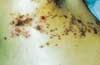
Ten days before presenting for evaluation, a 69-year-old man began to experience neuralgic pain and noticed the eruption of painful erythematous macules and papules on the right side of his chest. Within 24 to 72 hours, vesicles and pustules arose at the site. One week after onset, several of the lesions dried and crusted.
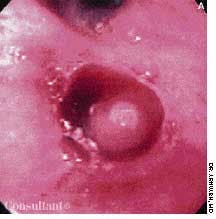
Squamous Cell Carcinoma of the Lung
September 14th 2005Over the past 6 months, a 72-year-old man was troubled by a persistent cough; he also had lost 9 kg (20 lb). He had no fever or chills, but he noticed mild streaking of blood in his sputum during the past month. He had been a cigarette smoker for 50 years.
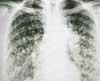
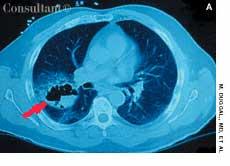
Cavitary Lung Cancer With Metastases
September 14th 2005A 60-year-old woman with a 3-month history of cough, chest pain, and shortness of breath was brought to the emergency department. The patient denied any history of fever, chills, or rigors; she complained of mild hemoptysis for 1 week and a 9-kg (20-lb) weight loss during the last few months. The patient had smoked cigarettes for 40 years.
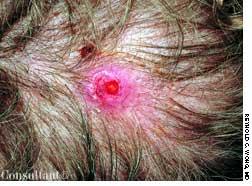
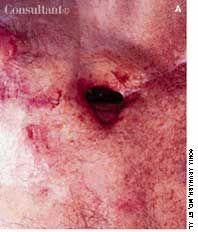
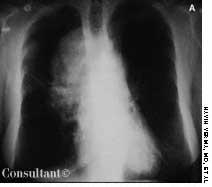
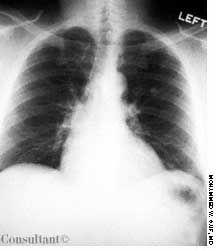
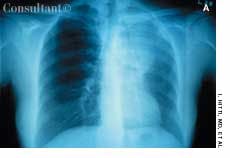
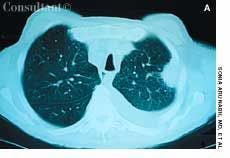
Adenocarcinoma of the Lung in a 67-Year-Old Man
September 14th 2005A 67-year-old man with a 5-month history of cough, shortness of breath, and pain in the left anterior chest wall sought medical evaluation. The patient denied fever, chills, and hemoptysis. He reported a recent weight loss of 25 lb. The patient had smoked cigarettes for 37 years.
Case In Point: Exfoliative dermatitis: A presenting sign of lung cancer
September 1st 2005A 53-year-old man presented with a 3-day history of bilateral pain in the lower extremities. He also had a 3-month history of thickening and desquamation of skin, with associated itching, and a 5-lb (2.27-kg) weight loss. The skin changes initially appeared on the hands and subsequently became generalized.

Older Man With Worsening Dyspnea,Chest Discomfort, and Cough
January 2nd 2003For the past 3 months, a 72-year-old man has had progressivelyworsening dyspnea on exertion and constantvague discomfort in the left chest that appears to have apleuritic component. He denies paroxysmal nocturnaldyspnea and has no history of chest trauma. However, hehas a chronic cough that sometimes produces purulentsputum-although it is not associated with hemoptysis.His feet swell occasionally, and he has mild anorexia andhas lost 20 lb in 6 months.
Women and Smoking-Related Diseases:The Scope of the Epidemic
November 1st 2002Smoking-related diseases have reached epidemic levelsamong women in the United States. Since 1980, neoplastic,cardiovascular, respiratory, and pediatric diseases attributableto smoking-as well as cigarette burns-havebeen responsible for the premature deaths of 3 millionAmerican women and girls. Lung cancer is now the leadingcause of cancer-related deaths among US women; itsurpassed breast cancer in 1987.1

